
Best Online Slots Welcome Bonus We provide information on all aspects of online gaming, providing reviews, recommendations and much much more in order to give you the boost you need to succeed when playing. Belfast Online Casinos As you launch the site in the browser you will be invited to play straight away. Bingo Slots No Deposit Required
We often regard learning as a torture. Actually, learning also can become a pleasant process. With the development of technology, learning methods also take place great changes. Take our JN0-351 practice material for example. All of your study can be completed on your computers because we have developed a kind of software which includes all the knowledge of the JN0-351 exam. The simulated and interactive learning environment of our test engine will greatly arouse your learning interests. You will never feel boring and humdrum. Your strong motivation will help you learn effectively. If you are tired of memorizing the dull knowledge point, our JN0-351 Test Engine will assist you find the pleasure of learning. Time is priceless. Learn something when you are still young. Then you will not regret when you are growing older.
If you are one of them buying our JN0-351 exam prep will help you pass the exam successfully and easily. Our Juniper guide torrent provides free download and tryout before the purchase and our purchase procedures are safe. Our JN0-351 exam torrent carries no viruses. We provide free update and online customer service which works on the line whole day. Our study materials provide varied versions for you to choose and the learning costs you little time and energy. You can use our JN0-351 Exam Prep immediately after you purchase them, we will send our product within 5-10 minutes to you.
The result of your exam is directly related with the JN0-351 learning materials you choose. So our company is of particular concern to your exam review. Getting the JN0-351 certificate of the exam is just a start. Our JN0-351 practice materials may bring far-reaching influence for you. Any demands about this kind of exam of you can be satisfied by our JN0-351 training quiz. So our JN0-351 practice materials are of positive interest to your future. Such a small investment but a huge success, why are you still hesitating?
| Topic | Details |
|---|---|
| Topic 1 |
|
| Topic 2 |
|
| Topic 3 |
|
| Topic 4 |
|
| Topic 5 |
|
| Topic 6 |
|
NEW QUESTION # 12
An update to your organization's network security requirements document requires management traffic to be isolated in a non-default routing-instance. You want to implement this requirement on your Junos-based devices.
Which two commands enable this behavior? (Choose two.)
Answer: B,D
Explanation:
Explanation
To isolate management traffic in a non-default routing-instance on Junos-based devices, you can use the set system management-instance and set routing-instances mgmt_junos commands12.
set system management-instance: This command associates the management interface (usually named fxp0 or em0 for Junos OS, or re0:mgmt-* or re1:mgmt-* for Junos OS Evolved) with the non-default virtual routing and forwarding (VRF) instance1. After you configure the non-default management VRF instance, management traffic no longer has to share a routing table with other control traffic or protocol traffic1.
set routing-instances mgmt_junos: This command creates a new routing instance named mgmt_junos. The name of the dedicated management VRF instance is reserved and hardcoded as mgmt_junos; you cannot configure any other routing instance by the name mgmt_junos1.
Therefore, options C and D are correct. Options A and B are not correct because they attempt to assign an interface to the mgmt_junos routing instance, which is not necessary for isolating management traffic1.
NEW QUESTION # 13
Exhibit.
What is the management IP address of the device shown in the exhibit?
Answer: A
Explanation:
Explanation
The management IP address of a device is the IP address that is used to access the device for configuration and monitoring purposes. It is usually assigned to a dedicatedmanagement interface that is separate from the data interfaces. The management interface can be accessed via SSH, Telnet, HTTP, or other protocols.
In the exhibit, the list of interfaces and their statuses shows that the management interface isme0. This interface has an admin status ofup, a protocol status ofinet, a local address of172.23.12.100/24, and a remote address ofunspecified. This means that the me0 interface is active, has an IPv4 address assigned, and is not connected to another device.
Therefore, the management IP address of the device shown in the exhibit is172.23.12.100.
References:
[Management Interfaces Overview] : [Displaying Interface Status Information]
NEW QUESTION # 14
You are receiving multiple BGP routes from an upstream neighbor and only want to advertise a single summarized prefix to your internal OSPF neighbors. This route should only be advertised when you are receiving these BGP routes from this neighbor.
In this scenario, which type of route should you create?
Answer: D
Explanation:
Explanation
In this scenario, you should create an 1. Aggregate routes are used for advertising summarized network prefixes1. They help minimize the number of routing tables in an IP network by consolidating selected multiple routes into a single route advertisement1. This approach is in contrast to non-aggregation routing, in which every routing table contains a unique entry for each route1.
Therefore, option A is correct. Options B, C, and D are not correct because:
Static route using the resolve feature: This type of route uses the resolve feature to install a static route in the routing table only if a specific condition is met1. However, it does not provide the capability to summarize multiple routes into a single prefix.
Generate route: This type of route generates a route that is always present in the routing table and can be used to summarize routes. However, it does not have the capability to only advertise the route when specific BGP routes are being received from a neighbor1.
Static route using qualified next hops: This type of route allows for the specification of multiple next-hop addresses for a static route1. However, it does not provide the capability to summarize multiple routes into a single prefix.
NEW QUESTION # 15
Refer to the exhibit.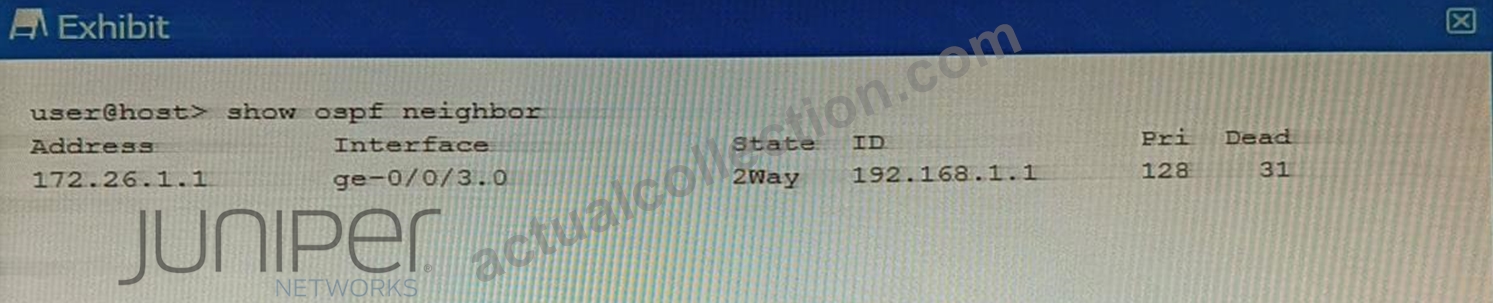
Referring to the output shown in the exhibit, which statement is correct?
Answer: C
Explanation:
Explanation
In OSPF, the state of the neighbor relationship is determined by the exchange of OSPF packets between routers1. The state "2Way" as shown in the exhibit indicates that bi-directional communication has been established between the two OSPF routers1. This is the normal state for a neighbor that is not the Designated Router (DR) or Backup Designated Router (BDR) on a broadcast, non-broadcast multi-access (NBMA), or point-to-multipoint network1. These neighbors are often referred to as "DRothers"1. Therefore, option B is correct.
NEW QUESTION # 16
Which statement is correct about controlling the routes installed by a RIB group?
Answer: B
Explanation:
Explanation
A RIB group is a configuration that allows a routing protocol to install routes into multiple routing tables in Junos OS. A RIB group consists of an import-rib statement,which specifies the source routing table, and an export-rib statement, which specifies the destination routing table or group. A RIB group can also include an import-policy statement, which specifies one or more policies to control which routes are imported into the destination routing table or group1.
An import policy is a policy statement that defines the criteria for accepting or rejecting routes from the source routing table. An import policy can also modify the attributes of the imported routes, such as preference, metric, or community. An import policy can be applied to a RIB group by using the import-policy statement under the [edit routing-options rib-groups] hierarchy level1.
Therefore, option A is correct, because an import policy is applied to the RIB group to control which routes are installed in the destination routing table or group. Option B is incorrect, because all routes in the source routing table are imported into the destination routing table or group, unless filtered by an import policy.
Option C is incorrect, because a firewall filter is not used to install routes in the RIB groups; a firewall filter is used to filter packets based on various criteria. Option D is incorrect, because an export policy is not applied to the RIB group; an export policy is applied to a routing protocol to control which routes are advertised to other devices.
References:
1: rib-groups | Junos OS | Juniper Networks
NEW QUESTION # 17
......
New developments in the tech sector always bring new job opportunities. These new jobs have to be filled with the Enterprise Routing and Switching, Specialist (JNCIS-ENT) (JN0-351) certification holders. So to fill the space, you need to pass the Enterprise Routing and Switching, Specialist (JNCIS-ENT) (JN0-351) exam. Earning the Enterprise Routing and Switching, Specialist (JNCIS-ENT) (JN0-351) certification helps you clear the obstacles you face while working in the Juniper field. To get prepared for the Enterprise Routing and Switching, Specialist (JNCIS-ENT) (JN0-351) certification exam, applicants face a lot of trouble if the study material is not updated.
Latest JN0-351 Test Cost: https://www.actualcollection.com/JN0-351-exam-questions.html