
Best Casino Bingo And Slots Vikings Go To Hell was released just in time for summer 2025 by Yggdrasil. Best Bnb Casino Uk Punters from Winnipeg, Toronto, Australia and Montreal are dipping into Betclic casino bonuses via the single wallet. Ethereum Casino No Deposit Bonus Uk
BONUS!!! Download part of DumpsFree AD0-E716 dumps for free: https://drive.google.com/open?id=10mkpX8fZmlHopK_kv0RnjNXHVnocIRso
Since the AD0-E716 study quiz is designed by our professionals who had been studying the exam all the time according to the changes of questions and answers. Our AD0-E716 simulating exam is definitely making your review more durable. To add up your interests and simplify some difficult points, our experts try their best to simplify our AD0-E716 Study Material and help you understand the learning guide better.
| Topic | Details |
|---|---|
| Topic 1 |
|
| Topic 2 |
|
| Topic 3 |
|
| Topic 4 |
|
| Topic 5 |
|
| Topic 6 |
|
| Topic 7 |
|
| Topic 8 |
|
>> AD0-E716 Test Collection Pdf <<
Use this AD0-E716 practice material to ensure your exam preparation is successful. Mock exams at DumpsFree are available in AD0-E716 desktop software and web-based format. Both Adobe AD0-E716 self-assessment exams have similar features. They create an Adobe AD0-E716 actual test-like scenario, point out your mistakes, and offer customizable sessions.
NEW QUESTION # 45
An Adobe Commerce developer has added an iframe and included a JavaScript library from an external domain to the website. After that, they found the following error in the console:
Refused to frame [URL] because it violates the Content Security Policy directive.
In order to fix this error, what would be the correct policy ids to add to the csp_whitelist.xml file?
Answer: B
Explanation:
The frame-ancestors directive specifies the domains that are allowed to embed the current page in an iframe. The connect-src directive specifies the domains that are allowed to be loaded by the current page through a <script> tag or XMLHttpRequest.
In this case, the developer has added an iframe that embeds a page from an external domain. The Content Security Policy (CSP) is preventing the iframe from being loaded because the domain of the external page is not listed in the frame-ancestors directive.
To fix this error, the developer needs to add the domain of the external page to the frame-ancestors directive. They can do this by adding the following line to the csp_whitelist.xml file:
<frame-ancestors>https://www.example.com</frame-ancestors>
NEW QUESTION # 46
What are two ways to access the PHP error logs on Adobe Commerce Cloud? (Choose Two.)
Answer: A,D
Explanation:
Two ways to access the PHP error logs on Adobe Commerce Cloud are to use the dedicated command from Cloud CLI for Commerce and to connect to the servers via SSH and localize the log files. The Cloud CLI for Commerce is a command-line tool that allows developers to interact with their Adobe Commerce Cloud projects and environments. The developer can use the command magento-cloud log php to view or download the PHP error logs from any environment. Alternatively, the developer can connect to the servers via SSH and navigate to the var/log directory where the PHP error logs are stored. Verified Reference: [Magento 2.4 DevDocs] 3
NEW QUESTION # 47
An Adobe Commerce developer is working on a custom gallery extension.
The module uses the MagentocatalogModeliinageUploader class for image uploading. The admin controller for custom image uploads is VendorCustomGalleryControllerAdminhtmlImageUpload.
The images need to be stored in different basePath and baseTmpPath than the default ones.
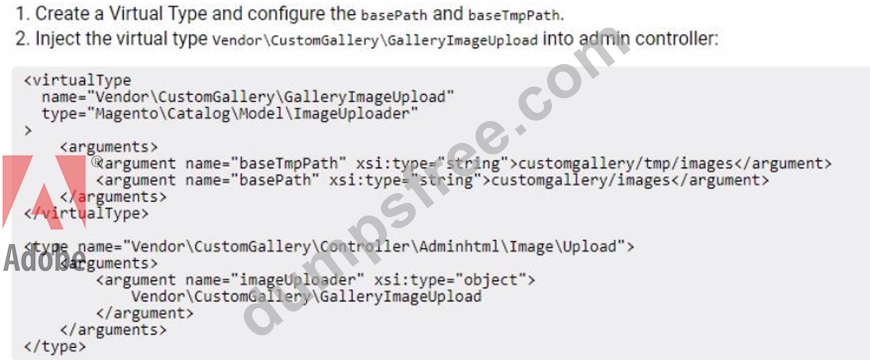
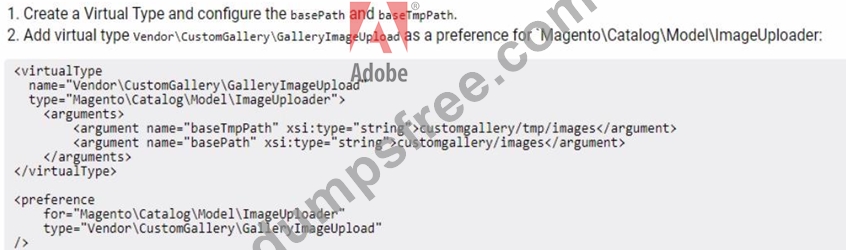
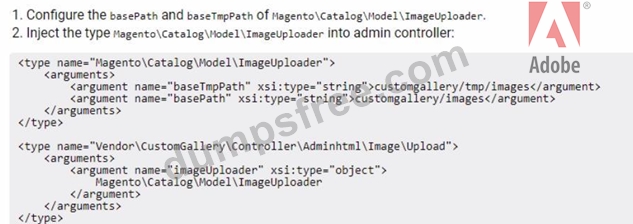
How can the default imageuploader class be extended and used without affecting the other modules that are already using it?
Answer: A
Explanation:
To extend the MagentoCatalogModelImageUploader class and configure it with custom basePath and baseTmpPath without affecting other modules that utilize this class, the best approach is to use a Virtual Type
. Virtual types allow you to create a customized version of a class for a specific context without altering the original class or its usage elsewhere.
Option A is correct for the following reasons:
* Creating a Virtual Type:By defining a virtual type (VendorCustomGalleryGalleryImageUpload) in the di.xml, you create a custom version of the ImageUploader class. This virtual type can have unique configurations for basePath and baseTmpPath, which are specific to the custom gallery module.
* Explanation: Virtual types are particularly useful in Magento when you need to use a slightly modified version of an existing class in a specific context. In this case, the virtual type allows you to define custom paths without altering the base ImageUploader class, ensuring that other modules using ImageUploader are unaffected.
* References: Magento's developer documentation on dependency injection and virtual types highlights this pattern for customizing class behavior in a contained and non-intrusive manner.
* Injecting the Virtual Type into the Admin Controller:The custom virtual type is then injected into the VendorCustomGalleryControllerAdminhtmlImageUpload controller. This ensures that only this controller uses the modified version with the custom paths, leaving other instances of ImageUploader to function with their default settings.
* Explanation: By explicitly injecting the virtual type into the controller, you localize the configuration changes to only the desired functionality. This approach is efficient and maintains module independence, a key principle in Magento development.
Options B and C are incorrect for the following reasons:
* Option B directly modifies MagentoCatalogModelImageUploader with the new paths. This change will affect all usages of the ImageUploader class across the site, which contradicts the requirement to avoid impacting other modules.
* Option C involves creating a virtual type and then setting it as a preference. However, using a preference would replace all instances of ImageUploader across the entire Magento application, leading to the same issue as Option B.
NEW QUESTION # 48
An Adobe Commerce developer added a new API method to search and retrieve a list of Posts for a custom Blog functionality. This is the content of the module's etc/webapi.xml file:
The new code has been deployed to production and the merchant is using https: //merchant. domain. com
/swagger to review the new endpoint, but it is not visible in swagger.
What would be a reason for this?
Answer: B
Explanation:
In Adobe Commerce, when defining new API endpoints through the webapi.xml configuration file, the visibility of these endpoints in tools like Swagger (now OpenAPI) depends on several factors, including authentication settings. According to the provided webapi.xml file:
<?xml version="1.0"?>
<routes xmlns:xsi="http://www.w3.org/2001/XMLSchema-instance"
xsi:noNamespaceSchemaLocation="urn:magento:module:Magento_Webapi:etc/webapi.xsd">
<route url="/V1/myvendor-blog/post/search" method="GET">
<service class="MyVendorBlogApiPostRepositoryInterface" method="getList"/>
<resources>
<resource ref="MyVendor_Blog::Post_View"/>
</resources>
</route>
</routes>
* Option A suggests moving the file to etc/webapi_rest/webapi.xml. However, this is incorrect because Adobe Commerce does not require separate XML files for REST and SOAP APIs in this context. The webapi.xml is used for defining routes for both. The structure and location provided in the question are correct for defining REST API routes.
* Option B is the correct answer. The resource reference MyVendor_Blog::Post_View indicates that this API endpoint is not anonymous; it requires authentication. In Adobe Commerce, if an API endpoint requires authentication, it won't be visible in Swagger (or the OpenAPI UI) unless you provide valid authentication credentials or tokens. This is part of Magento's security model where protected resources require tokens or OAuth to access. For the merchant to see this endpoint in Swagger, they must provide an integration token or OAuth token which has permissions for MyVendor_Blog::Post_View. This is detailed in the Adobe Commerce Developer Documentation under [Web API Authentication](https://x.
com/i/grok?text=Web%20API%20Authentication).
* Option C mentions the @return annotation missing in the interface class. While proper annotations in PHPDoc are important for IDE autocompletion and documentation generation, they are not directly related to the visibility of an endpoint in Swagger. The visibility in Swagger is determined by the configuration in webapi.xml and the authentication settings, not by PHPDoc annotations. Thus, this option is incorrect in the context of the question.
For further reading on how to manage and configure API endpoints in Adobe Commerce, including authentication, refer to the official Adobe Commerce Developer Guide:
* Web API Configuration
* Web API Authentication
* Swagger Integration for testing and documenting APIs.
This explanation covers the necessary aspects of Adobe Commerce API development, focusing on the configuration, authentication requirements, and how these affect the visibility of API endpoints in development tools like Swagger.
NEW QUESTION # 49
An Adobe Commerce developer is asked to implement a 15% surcharge for all users from a 'Wholesale' customer group. Keeping best practices in mind, what is a correct to accomplish this?
Answer: B
Explanation:
product from the $observer->getEventC) data and Call $product->setData('final_price', $product->getData( 'final_price') * 1.15).
Explanation:
The possible reason why the payment method is missing in the admin is that in the module config.xml, the node can_use_internal was not set to true. This node determines whether the payment method can be used in the admin area or not. If it is set to false or omitted, the payment method will not be available for admin orders. To enable the payment method for admin use only, the node can_use_internal should be set to true and the node can_use_checkout should be set to false. Verified Reference: [Magento 2.4 DevDocs] [Magento Stack Exchange]
NEW QUESTION # 50
......
The candidates can test themselves for the Adobe Commerce Developer with Cloud Add-on exam day by attempting the Adobe Commerce Developer with Cloud Add-on AD0-E716 practice test on the software. There is preparation material available on the AD0-E716 Practice Exam software by DumpsFree to study for the Adobe AD0-E716 test.
AD0-E716 Real Brain Dumps: https://www.dumpsfree.com/AD0-E716-valid-exam.html
BTW, DOWNLOAD part of DumpsFree AD0-E716 dumps from Cloud Storage: https://drive.google.com/open?id=10mkpX8fZmlHopK_kv0RnjNXHVnocIRso